Cara a Cara: What I Got Right in 2014 — and What I Missed
In 2014 I published research arguing that hotels should use telepresence to create more human moments. 8 out of 10 survey respondents said they'd try 'teledining'. It never happened. Here's what that tells us about technology adoption — and what the industry still gets wrong.
There is a sentence I wrote in 2014 that I still think about: ¿Podemos pensar en los hoteles como centros de conexión humanos e interacción? — Can we think of hotels as centers of human connection and interaction?
I was writing my master's thesis at CETT–Universitat de Barcelona. The paper was called "Cara a Cara: adaptándose a nuevos tiempos" — face to face: adapting to new times. The argument was specific, and in retrospect, stranger than it first appeared.
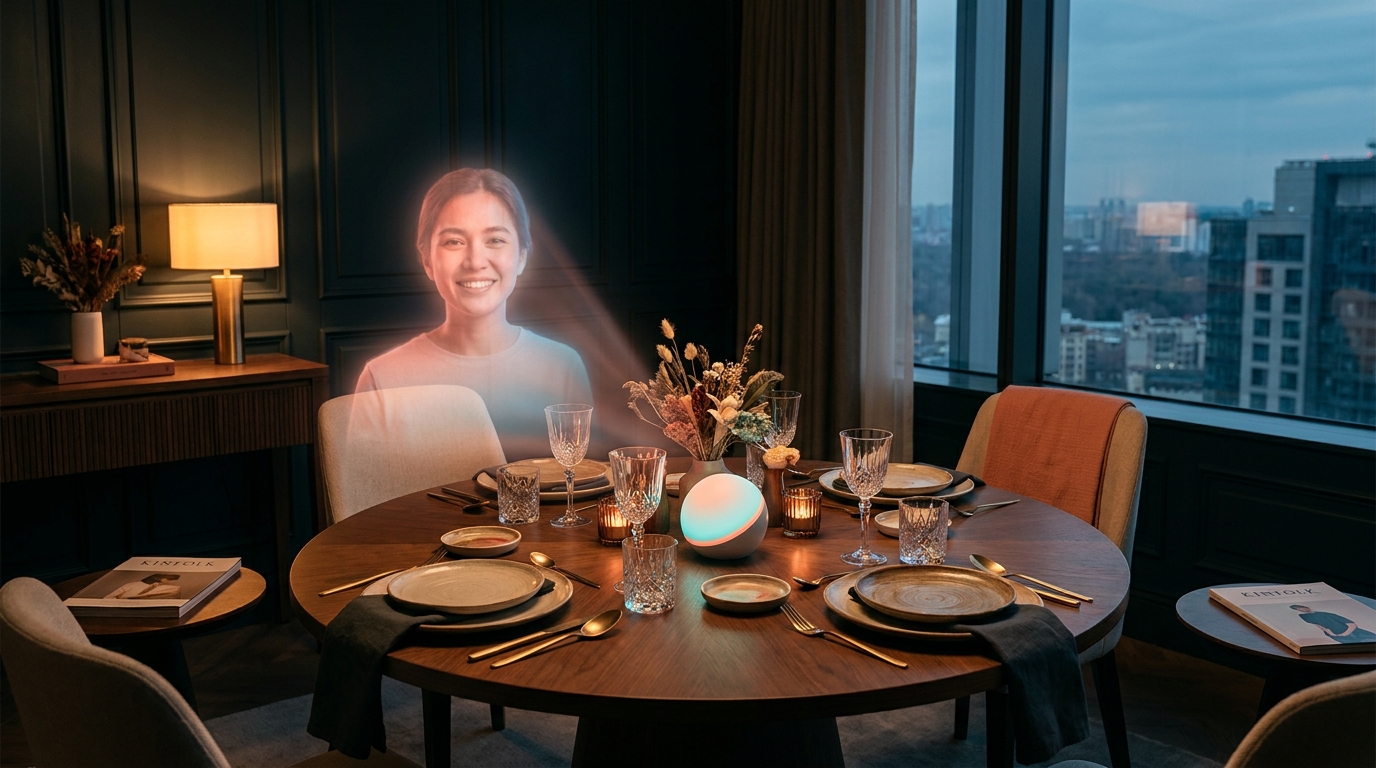
I wasn't writing about making hotels more human by removing technology. I was arguing the opposite: that videoconference and telepresence technology could be used to create more face-to-face moments inside hotels. That a business traveler alone in a hotel room in Singapore could share a dinner table with their family in Santiago — virtually but genuinely. That the hotel lobby could become a space where being far from the people you love felt a little less true.
I called the concept "teledining." I surveyed people from America, Europe and Asia. 8 out of 10 said they'd try it.
It never happened.
Twelve years later, with AI at every front desk and Zoom a household word, I think it's worth checking the math.
What the paper actually argued
The survey data was clear about one thing: 62% of respondents still preferred to interact directly with physical service staff when they needed help. Even among people who used videoconferencing regularly — and 8 out of 10 did, with half using it at least once a week — there was a strong instinct to seek out the person in the room.
But the same data showed something interesting: people's relationship with video calls was deeply contextual. 71% used it to call family. 60% to call friends. Only 40% for colleagues. The medium was intimate — associated with people you already knew, in spaces of comfort (home, office, hotel room). Taking a video call with a stranger felt cold. Taking one with your mother while having dinner didn't.
This is what the teledining concept was built on. Not "videoconference as business tool." Videoconference as the thing that makes being away from home feel slightly less lonely. Half the respondents said they had a hot drink during video calls. 60% drank water. The average call lasted 30 minutes. These were people sharing presence, not conducting meetings.
The hypothesis I proposed was that hotels — specifically large international chains with presence in multiple cities — could build this into the service. Not as a replacement for human staff, but alongside it. The hotel as a node in a network of connection, not just a room for sleeping.
What I got right
The hotel-as-hub idea turned out to be correct — just slower than I expected, and driven by forces I didn't anticipate.
The hospitality industry spent the decade after 2014 discovering that business travelers don't just want a bed. They want a workspace. Then a community space. "Work from hotel" day passes became a product category. Hotel lobbies were redesigned around communal tables and fast wifi. The Marriott Bonvoy lounge, the Soho House model, the Hoxton — all of them are versions of the social hub I was sketching.
And the generational prediction held. I wrote extensively about Gen-Y and Gen-Z's natural adoption of technology and their expectation that digital connection would be woven into physical spaces. That's not a prediction anymore — it's a baseline assumption for any hotel that wants guests under 40.
The behavioral data also held: 8 in 10 respondents said they'd use video calls during hotel stays. That's now completely normal. The question was never whether people would do it; it was whether the hotel would design around it or ignore it.
What I missed
The teledining concept never scaled. Not because people didn't want it — the survey said 8 out of 10 would try it — but because the barrier was not desire, it was imagination.
I identified this in the conclusions: "Las personas tienen dificultades a visualizar las ocasiones o oportunidades para realizar una teledining y como realizarla." People struggle to visualize when and how to actually do it. The concept made sense when described. It didn't naturally occur to anyone as a booking option.
This is a design problem, not a technology problem. And it's a pattern I've seen repeated across every hospitality technology deployment I've worked on since: the technology works, the guests would use it, but the organization never builds the ritual around it that makes it obvious.
The other thing I missed was the supply side problem. My proposals were targeted at large international chains — the ones with global reach, consistent brand standards, and the infrastructure to run this at scale. Those organizations moved slowly. The fast-moving technology companies who might have built this (Airbnb, Booking.com) had no interest in the physical guest experience.
And then I missed AI entirely. The paper was about a specific form of remote presence technology. AI is the next form — one that creates the appearance of human presence without requiring a human at all. That changes the problem completely.
The thing I got most right, without knowing it
Buried in the conclusions: "Cambiar esta percepción es el mayor desafío al momento de desarrollar servicios en este campo." Changing perception is the biggest challenge when developing services in this area.
I was writing about telepresence feeling "impersonal" or "cold" to guests unfamiliar with it. But the sentence describes something universal in hospitality technology adoption, and it describes the AI problem too.
The issue is not that guests don't accept technology. They do — we've watched it happen in real time. The issue is that technology feels impersonal when it's visible as technology. The moment a guest thinks "I'm talking to a bot," or "this email was generated," something collapses. Not trust in the functionality — trust in the relationship.
My 2014 rule was this: technology must be introduced gradually, so that guests build their own experience with it and form their own impressions. The hospitality organizations that deployed it well did exactly this. The ones that failed tried to shortcut the process — launched the chatbot without training the team, installed the telepresence unit without building a use case, added the AI response without telling the guest.
In 2014 I was writing about telepresence. In 2026, I'm writing about AI. The technology is different. The adoption problem is identical.
The hotel of the future — whether the room, the restaurant, or the lobby — will have more technology in it than the hotel of 2014. Some of that technology will create genuinely human moments. Some of it will quietly destroy them.
The difference is almost never in the technology itself. It's in whether the people running the hotel understand that the technology serves the connection, not the other way around.
That's what "Cara a Cara" was trying to say. I think it still stands.
"Cara a Cara: adaptándose a nuevos tiempos" (2014) was researched and written at CETT–Universitat de Barcelona as part of the Master Universitario de Dirección Hotelera, supervised by Andreu Vilagines Mollevi. Survey data collected from respondents in Americas, Europe and Asia. If you're working through these same questions in your operation today, let's talk.
Felipe Díaz Marín has twenty years in hospitality across four continents, twelve of them at CY Cergy Paris Université. He builds AI automation for hospitality teams and learning products (free during the beta). Based in Paris.